Thursday, April 30, 2026

Suffering’s fulfillment

He who saw it has borne witness—his testimony is true, and he knows that he is telling the truth—that you also may believe. For these things took place that the Scripture might be fulfilled: “Not one of his bones will be broken.” And again another Scripture says, “They will look on him whom they have pierced.” John 19:35-37

Here John pauses the crucifixion narrative in order to emphasize the reliability of what he himself witnessed on the cross: “He who saw it has borne witness… that you also may believe”. Standing at the foot of the cross, John recounted as an eyewitness not just tragedy — he is also testifying to fulfillment. The piercing of Jesus’ side and the preservation of Jesus’ unbroken bones were not just random details, they are part of the outworking of God’s eternal salvation plan. It may all have seemed cruel chaos and yet, in truth, it was a precise unfolding of prophetic scripture. The cross is not an interruption of God’s purpose… it is the climax of our salvation coming into being.

John highlights that “not one of his bones will be broken,” echoing the Passover lamb (Exodus 12:46). And that “they will look on him whom they have pierced” (Zechariah 12:10). Jesus suffers exactly as scripture foretold, revealing that He is both the Passover Lamb and the promised Savior. This is not accidental suffering — it is substitutionary. Each detail reinforces that Christ willingly bore the weight of all our sin under the sovereign wrath of God. The same scriptures that predicted His suffering also assure us that His sacrifice is sufficient. The cross is not just a place of pain, but a place of profound purpose — God accomplishing redemption as He always planned it through the obedience of His only Son.

Because Jesus’ suffering fulfilled Scripture with precision, our faith rests on something unshakeable. The gospel isn’t just wishful thinking; it is anchored in the sure promise of God, carried out in real events in human history. This gives us certainty in an insecure world. Christ is crucified and risen! His work stands and cannot be undone. So we praise our unbroken Lamb and pierced Savior! His is now our risen, almighty King — He fulfilled every scripture to save us! Joyfully we fix our gaze on Him, knowing that the God Who fulfilled these promises will surely see us home to stand alongside King Jesus forever!


Tuesday, April 28, 2026

Listen up!

Yet you have not listened to me, declares the LORD, that you might provoke me to anger with the work of your hands to your own harm.​  Jeremiah 25:7

This was a sad pattern in Israel’s history: “…you have not listened to me…” Again and again, for decades, God had sent prophets to His people, patiently calling them to turn from their sin. They had no lack of revelation. They simple refused to receive it. Their ears heard, but their hearts rebelled. They chose false, selfish voices over God’s voice, and their “independence” was in fact willful, disobedient rebellion. Jeremiah reminds us that ignoring God’s Word is never neutral — it is a deliberate rejection of God, Who speaks for our good.

Refusing to listen hardens us over time. What we resist today is much easier to dismiss again tomorrow. Scripture is meant to correct, reprove, warn, guide, and lovingly lead, but when we push it aside, we attempt to reshape reality around our own desires. Like Judah, we may outwardly look quite religious while also pursuing idolatry that pulls us from the Lord. And this will provoke God’s righteous anger — not because God is harsh, but because He is holy and just. He loves us too much to let us ignore Him! To disregard His Word is to reject His authority, and that invites consequences of living apart from Him.

The gospel meets us here. We have refused to listen, but Jesus perfectly listened. He heard and taught every Word of the Father and obeyed without fail, revealing the Father, and becoming obedient to death on a cross. There, He bore God’s wrath that our sins had provoked. There is now forgiveness for our rebellion and a new heart for those who believe. We listen to Jesus and are saved! He obeyed so that we can hear, believe, obey, and find life.

Monday, April 27, 2026

Fire and Hammer

Jeremiah 23:29

Is not my word like fire, declares the LORD, and like a hammer that breaks the rock in pieces?

FLAME of truth streams from the mouth of God,

IGNITING hearts that once were frozen in sin,

REFINING souls like gold within the furnace,

EXPOSING all that pride can hide within.


A living Word that cannot be contained,

NO human strength can blunt its piercing edge,

DIVIDING bone and marrow, it speaks and all creation trembles.


HELD by heaven, striking hearts hard as stone,

AWAKING life where deadness once ruled,

MERCY resounds with each hammer blow,

MAKING a path for grace and truth to flow.

EVERY proud refuge shattered by Word’s force,

REVEALING Christ — the Living Word Who saves and restores.

Friday, April 24, 2026

The Sword and the Cup

So Jesus said to Peter, “Put your sword into its sheath; shall I not drink the cup that the Father has given me?”​ John 18:11

A blade flashed bright with borrowed courage, metal singing what fear could not confess.

A fisherman grasping at kingdoms of the earth; he swung at circumstances, making them enemies.

The sword spoke quickly, sharply, in a language of defense and desperation;

It cut flesh but could not cut fate; nor silence the will of the Father.

Yet Jesus stood unarmed, unwavering, rebuking the violence burst forth to save Him;

“Put it away,” he said — not to deny power, but to reveal His deeper obedience and confidence.

For there was another weapon, unseen — a cup, heavy with wrath and mercy mixed —

poured out not by Rome, nor priestly hands, but prepared by the Father Himself from ages past.

Peter fought to stop the suffering; Jesus willingly fulfilled it.

One trusted the strength of his grip on the hilt of his sword.

The Other gripped the purpose of the cup, drank it up, and secured victory in the final battle forever for us.

Thursday, April 23, 2026

steady heart

He is not afraid of bad news;

his heart is firm, trusting in the LORD.

His heart is steady; he will not be afraid,

until he looks in triumph on his adversaries.

Psalm 112:7-8

Psalm 112 celebrates the life of a man who fears the Lord, portraying a person whose righteousness flows into generosity, stability, and generational influence. The psalm contrasts the quiet strength of the faithful with the final frustration of the wicked, revealing that a God-centered life is both fruitful and secure.

Verses 7-8 give a picture of that inner steadfastness: no fear, firmness of heart, trust, steadiness, and triumph. This is not a promise of a life free from trouble or opposition. Instead, this is a description of a heart so deeply anchored in the fear of the Lord that fear in this world cannot shake it. The repetition of “his heart is firm… his heart is steady” drives home that such stability is never personality-based, self-help derived, or mere whistling in the dark. It is trust-based, anchored deep in faith and trust in God and His Word. It is a settled confidence that God is sovereign, present, and faithful even when circumstances might be bad and shake us.

We are invited into honest reflection. Where does our security truly rest? Our world is saturated with alarming realities and uncertain outcomes. WIll we drift to uncontrolled anxiety or self-reliance? We are called back in the words of Psalm 112 to a cultivated trust — one formed by what we know of God’s perfect character and unfailing promises. This heart will not deny the presence of fear, but refuses to give fear any authority over it. This heart leans on faith to stand firm, not because life is good or predictable, but because God is good and faithful.

This unshakeable heart finds its rest in Jesus Who faced the worst “bad news” for us and became our “good news” in the gospel. He has triumphed over sin, hell, death, and the devil, giving us triumph over all adversaries. Nothing can overturn what He has accomplished. Our hearts can be firm in Christ, growing strong and staying fearless as we rest in His saving work now finished for us.


Wednesday, April 22, 2026

A mirror and a mercy

“‘And many nations will pass by this city, and every man will say to his neighbor, “Why has the LORD dealt thus with this great city?” And they will answer, “Because they have forsaken the covenant of the LORD their God and worshiped other gods and served them.”’”  Jeremiah 22:8-9

God has His reasons for bringing about the judgment associated with His holy wrath and justice. In the case of the fall of Jerusalem to Nebuchadnezzar, it was to honor His Word. The Jews had made a covenant with God, and ten tribes in Israel had already been judged by the destructive hordes of the Assyrian empire.

Judah would fall next. Why? Because just like the northern kingdom of Israel, Judah too had forsaken the covenant of the Law. The city of Jerusalem was unfaithful, full of idols, and ripe for God’s judgment. When the Babylonians ransacked the city and carried the able-bodied living residents away captive, they were doing so exactly as God described that they would. The Word of God was true even in harsh judgment.

Had the city of Jerusalem heeded the Word of the prophets, repented of their idolatry, and turned to God in real worship-filled repentance, they could have been spared. But they did not. In love for His people and in the commitment to His covenant, God let them go into this exile, the city now a smoldering ruin, in order to discipline them back to renewing their worship and covenant commitment while in captivity. For seventy years Jerusalem would remain a broken down ruin, God’s people humbled, broken, and repentant, in order to restore covenant faithfulness again.

Just as nations passed by the ruins of Jerusalem wondering why a great city could fall, only to be pointed to the God of the covenant, so that striking image calls us today to sober self-examination. Outward affiliation with Christ means nothing if the heart drifts to idols of comfort, convenience, or selfishness. The gospel shows us this as both a mirror and a mercy. Jesus was faithful when we could not be, revealing our own need for salvation by taking our judgment. We pass by the cross marveling that Jesus died and was raised again to redeem us from our unfaithfulness and restore us in holy mercy and grace. He was forsaken because we had forsaken Him. But now we know great mercy because outside Jerusalem, He redeemed captives back from exile forever! 

Tuesday, April 21, 2026

His prayer, our prayer

I made known to them your name, and I will continue to make it known, that the love with which you have loved me may be in them, and I in them.  John 17:26

Before the night breaks into full betrayal,

Jesus lifts His eyes instead of His hands,

speaking not to the disciples 

but to the Father Who sent Him —

a prayer that gathers us into its center.


He names glory not as escape,

but as obedience completed;

a life poured out like wine into glass,

every word entrusted, every step on purpose,

the invisible God made known in flesh.


He prays for those given to Him,

fragile men with dust on their feet,

kept not by their strength, but by His Name,

guarded by truth against a world that resists it,

even as He was sent — into the same resistance.


Not removed, but rooted,

not sheltered, but sanctified,

set apart by a Word that wounds and heals,

a unity not built by their efforts

but born from shared life in Christ.


And then — astonishing mercy — He widens the circle:

Not only these, but all who will believe,

drawn into the same love that held Him,

the same nearness He has always known —

children like us welcomed into the Father just as the Son is.

Monday, April 20, 2026

Mighty beyond the flood

The floods have lifted up, O LORD,

the floods have lifted up their voice;

the floods lift up their roaring.

Psalm 93:3

The Lord reigns — unshaken, unhurried, clothed in strength like an armor no storm can pierce. The world does not wobble in His sure hands; it stands firm as he establishes it. Long before the first wave rose or the first voice raised a chaotic cry, His throne was set. He has never felt threatened, never surprised, never overpowered. From everlasting to everlasting, YOU ARE GOD!

But the floods are loud. Human culture swells like roaring waters — voices clashing, opinions surging, movements colliding, each one claiming power or demanding allegiance. Their noise is relentless, like breakers crashing the shore, eroding foundations to sweep away the weak. The world promises life but carries souls to destruction — confusion, pride, rebellion, and despair rush together in a seemingly Irresistible tide.

Yet above the roar, beyond the chaos, against the tsunami that carries a culture along, the Lord is mightier. His voice is not dissonant or frantic like the sound of the storm or the rush of the flood. God is steady, sovereign, and sure.

And God’s Word stands. What He has spoken is trustworthy — completely reliable for all of eternity! Holiness marks His house, and truth secures His promises. This is where His people rest their hope… not in the shifting currents of culture, but in His unchanging gospel. Jesus Christ has come, died, and risen, securing a kingdom that cannot be wiped away. When everything else feels like it is being swept downstream, the gospel remains solid ground. The Lord reigns — and because Jesus reigns, those who trust Him will forever stand with Him.

Friday, April 17, 2026

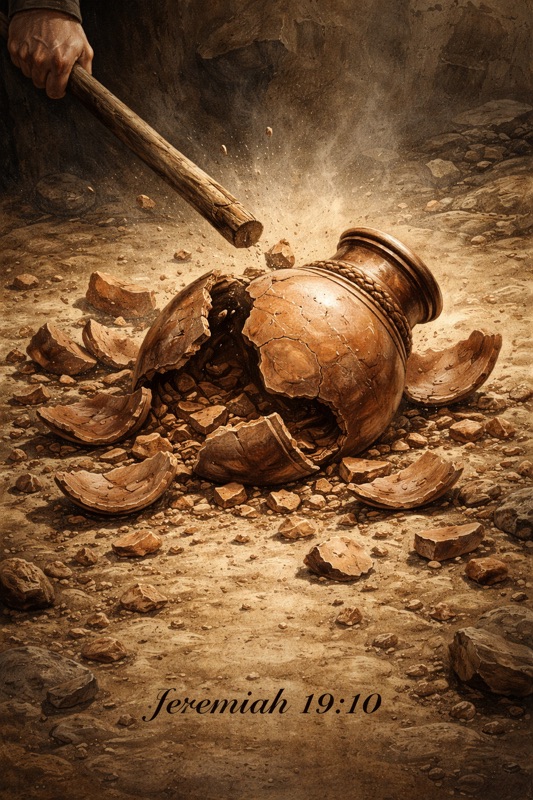
The Potsherd Gate

Then you shall break the flask in the sight of the men who go with you, and shall say to them, ‘Thus says the LORD of hosts: So will I break this people and this city, as one breaks a potter's vessel, so that it can never be mended.  Jeremiah 19:10-11a

Somewhere

Potsherd Gate: amid the shards

of broken clay pots

an object of wrath

was broken to show

leaders how final consequences

would come to a nation.


Scattered

in a graveyard of clay

was a flask shattered

in a message from God

left to be forgotten

but the lesson remembered:

God would break His people


Unshaken

by the experience of brokenness

and unfazed by warning

Sin was unrepented

men were unheeding

a city was unyielding

a nation was unhealed


Voided

the plans of Judah failed

the hopes of Jerusalem dashed

until another greater One came

outside another gate He offered

Himself broken and spilled

to restore a shattered world whole in Him

Thursday, April 16, 2026

Advocate and King

I came from the Father and have come into the world, and now I am leaving the world and going to the Father.  John 16:28

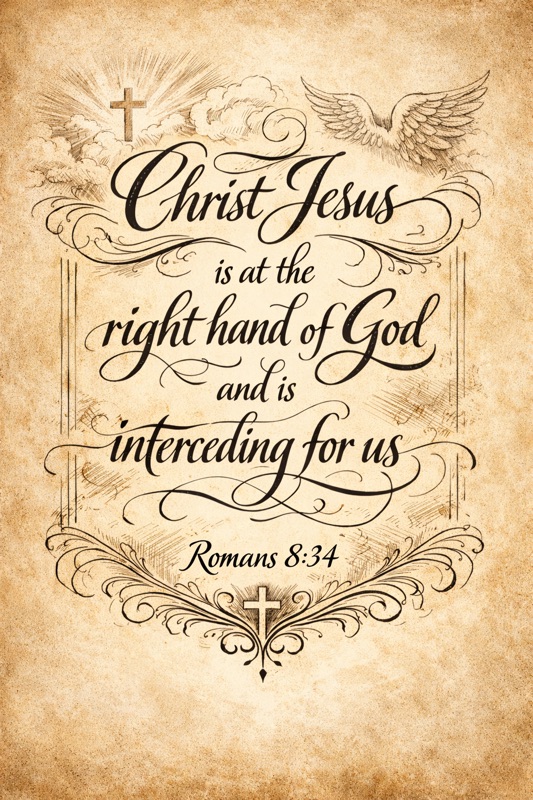
In this sentence Jesus reveals the entire arc of redemption — His eternal pre-existence, His incarnation, His life, and His return to the Father. But His departure isn’t abandonment; it is advancement. Hebrews 4:14 builds on this, informing us that Jesus is now our Great High Priest. He left, but now stands in the presence of the Father on behalf of every believer. The One Who walked among us now represents us, carries our weakness, our needs, and our sorrows and failures before the throne of God.

Christ’s present ministry is our consistent hope. He always lives to make intercession for us (Hebrews 7:25). When we feel the weight of sin or the heaviness of life, we aren’t left alone. Romans 8:34 assures us that He is at the Father’s right hand — near and interceding for us. This is grounded in His finished work on the cross. Because He has already paid our sin debt, His prayer is effective, securing our forgiveness, sustaining our faith in Him, and guaranteeing that nothing can separate us from the love of God in Him. Our prayers may feel faltering. His never do.

He will not stay there in intercession forever though. Acts 1:11 promises that the same Jesus Who ascended to the Father will come again. Our Great Hight Priest is our coming King. His current intercession assures a future deliverance. He is coming to bring us home! We live between two certainties: Christ is for us now, and Christ is coming for us soon. Our hearts rest in our Advocate. Our hopes rise anticipating our coming King.


Wednesday, April 15, 2026

He is perfectly pure.

Worship the LORD in the splendor of holiness;

tremble before him, all the earth!

Psalm 96:9

Here is a symphony of worship that calls all creation to lift praise to the Lord. The psalmist paints metaphor upon metaphor in Psalm 96: singing a “new song”, proclaiming good news of salvation day after day, declaring God’s glory among the nations of the earth, and ascribing to God the honor His name is due. Worship is no mere private practice, but is a global, joy-filled concert of loud celebration. Even the physical world of creation joins in: the heavens rejoice, the seas roar, the fields exult, and the trees sing for joy before their Lord and Creator. The whole world is a sanctuary, alive with loud praise, because the Lord reigns.

At the center of this worship concert stands the command: “worship the LORD in the splendor of holiness”. This draws our attention to the beauty and purity that belong to God alone. His holiness in not a distant distinction — it is radiant, weighty, and awe-inspiring. To worship in this splendor is to come before God with reverence, humility, and a heart that is captured by the unique beauty of His sheer, majestic holiness. It shapes our inward motivations for worship by the very character of God Himself. We don’t just acknowledge His holiness as part of a larger collection of theological factoids, but we admire it, reflect upon it, are captivated by it, trembling in the presence of beauty… filled with the joy of reverencing the One Who is perfectly pure and close to us.

And we know in Christ that a holy God makes a way for unholy people to draw near to Him. Jesus clothes us with His righteousness so we can stand in the presence of “the splendor of holiness”, not by our own merit, but by His grace. Jesus is the “new song” we sing. “He will judge the world in righteousness”. Christ saves us so that Psalm 96 is our praise, allowing us to worship in reverence and joy because He is the Lord that reigns!

Tuesday, April 14, 2026

justice / mercy

“Therefore, behold, I will make them know, this once I will make them know my power and my might, and they shall know that my name is the LORD.”​  Jeremiah 16:21

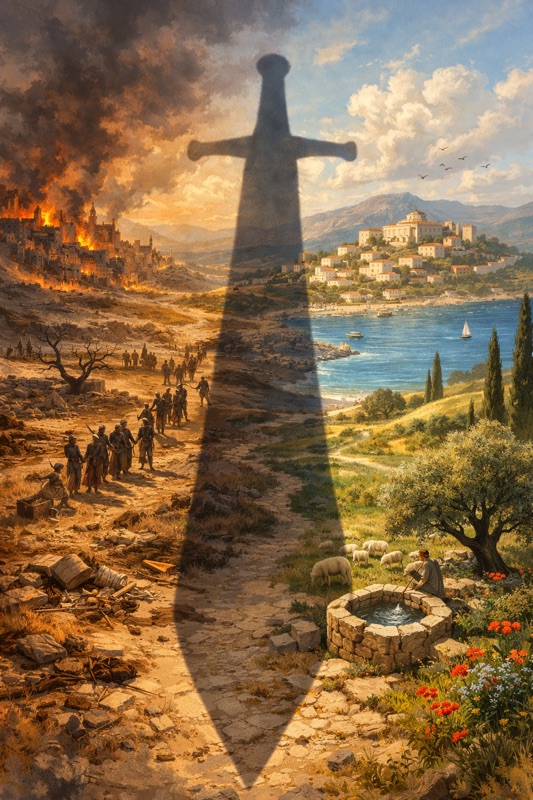
There fell a shadow of a sword

a prophet foretelling the Lord’s command

no border can silence the voice of the Lord

no grave conceal what God has planned

Judgment burned in righteous flame,

declared by Jeremiah’s cry;

a people who scorned God’s holy Name

would reap their ruin drawing night

From cruel north their exile came

a net of nations, fierce and wide;

each idol trusted was put to shame

each false confidence a lying guide

The land would be fallow beneath a curse

the echos of weeping ring in the air

sin would run its fatal course

and justice answered every prayer

Yet mercy whispered in the night

God’s promise deeper than their fall,

“I will restore, I will set right

and gather again my scattered all.”

Monday, April 13, 2026

hated

Whoever hates me hates my Father also.  John 15:23

Here Jesus speaks with sobering clarity the night before His crucifixion. These words come in the midst of His Upper Room discourse (as recorded by John), where He prepares His disciples for life after His departure. He has just encouraged them with the image of abiding in Him as the True Vine and then makes an immediate turn to the reality of persecution. The hatred in this world is not random — it is focused on the rejection of the Father as revealed through His Son. Everything Jesus said and did left no excuse for unbelief. To reject so much clear revelation in His miracles, teaching, and life was to clearly and willfully reject God Himself.

We are reminded that opposition to Christ is not merely a mistake of misunderstanding but is the rebel heart’s resistance to God’s authority, truth, and power. Jesus did not hide in obscurity; He came doing works and “signs” that no one else did. His life was a powerful display of God’s love and ability, yet many hated Him. This is a deep sin. People do not merely ignore God — they reject God. For believers, this reframes the hostility we may encounter. When the world rejects Christ, may it not be a failure of gospel clarity or a lack of the compassion of Christ seen in us! It is a reflection of the same spiritual blindness that Jesus encountered.

Yet this difficulty does not lead us to withdraw — it compels us to love more seriously by sharing the gospel. Christians proclaim the gospel not with fear or in anger, but with a steady, relational, caring love. We too were once resistant, yet God chased after us in mercy with His truth. And we heard it from a Christian who cared. Se we speak Christ clearly, live with integrity, and entrust the results to God’s Spirit. Love never retreats when rejected. Jesus didn’t. Like Jesus we stay on mission even when hated. God redeems and befriends His enemies… and this is our story.

Friday, April 10, 2026

Drenching the drought

Are there any among the false gods of the nations that can bring rain?

Or can the heavens give showers?

Are you not he, O LORD our God?

We set our hope on you,

for you do all these things.

Jeremiah 14:22

The land dries up

grass withers

ground cracks

crops fail

rivers dwindle

wells empty

and in our thirst

we know

You have withdrawn

the mercy of Your rain


We cry out

souls parched

lives cracked

hope fallen

resources exhausted

hearts broken

and in our need

we acknowledge

we have gone far

away from Your mercy again


You hear us repent

and unleash

pouring rain

restoring life

flowing water

filling up

what once was empty

and in our gratitude

we praise

You Who give

grace in healing streams

Thursday, April 9, 2026

Confident communion

Whatever you ask in my name, this I will do, that the Father may be glorified in the Son.​  John 14:13

This is a staggering promise. In context, Jesus is preparing His disciples for His death, resurrection, and ascension, assuring them His work will go on through them as they rely upon Him in prayer. To ask “in my name” is not formulaic. It is a posture of trust and proper alignment — praying according to Who Jesus is, what He has accomplished, and what He desires. Prayer is not about leveraging God as if He can be bent to our will. It is a continuation of Christ’s mission so that the Father is glorified in the Son by His disciples.

This promise has gospel depth. Because of sin, we are naturally separated from God, unable to approach Him. But through Christ, we are brought near and given access to the Father by means of His death and resurrection. We have instant access! When we pray in Jesus’ name, we come on the basis of His righteousness and not our own merit. Our prayers are heard because He is our mediator, our great high priest, interceding on our behalf. This transforms prayer into confident communion — God hears us because He hears His Son and He delights to answer in ways that magnify Christ.

Let prayer be gospel-shaped: bold yet humble, confident yet surrendered, for the glory of Jesus alone. We ask, not driven by comfort, selfishness, or convenience, but for a desire that His kingdom advances in changed hearts and lives. We do not obsess about answers or delays, trusting that Jesus is fulfilling His promise to the glory of the Father. Come to God through Christ. Abandon self-reliance. Believe that the gospel shapes how to talk to God. Pray by faith that God will do in our requests all that is able to bring glory to Himself and His beloved Son.

Wednesday, April 8, 2026

sin’s desolation

They have made it a desolation;

desolate, it mourns to me.

The whole land is made desolate,

but no man lays it to heart.

Jeremiah 12:11

Here is a picture of a land laid waste. God speaks of Judah as His cherished inheritance that has been trampled, neglected, and handed over to ruin because of their willful unfaithfulness (Jeremiah 12:7-13). The people once set apart to reflect His glory instead lusted after idols, trusted in false self-security, and abandoned His Word. The result was both external devastation AND a spiritual barrenness — a land that “mourns” because its people, who had broken covenant, refused to mourn over their sin.

Breaking faith with God always leads to empty desolation. It may appear appealing at first — compromise, “self-fulfillment”, secret pleasures — but eventually the soul is stripped bare. Judah still had religious language and an outward identity, but inwardly they were estranged from God. Even today, hearts can drift from God while maintaining appearances. Yet they will know dryness, distance, and unrest. Sin promises what it can never deliver; it erodes what God had made to flourish. This is the state of any human heart that turns its back on God’s goodness.

God’s warning here is a mercy. He exposes devastation so that His people might return to Him. We can repent of broken faith and believe the gospel. Turn from the sin of self-deceived false worship and trust anew in Christ, Who bore our unfaithfulness and restores what sin decimates. In Jesus the dry, desolate heart can be made to live again. Turn from ruin! Come… be renewed in Christ. Sin brings desolation. The grace of God in Christ is life, restoration, and joy!

Tuesday, April 7, 2026

to know, to love, to serve

If you know these things, blessed are you if you do them.  John 13:17


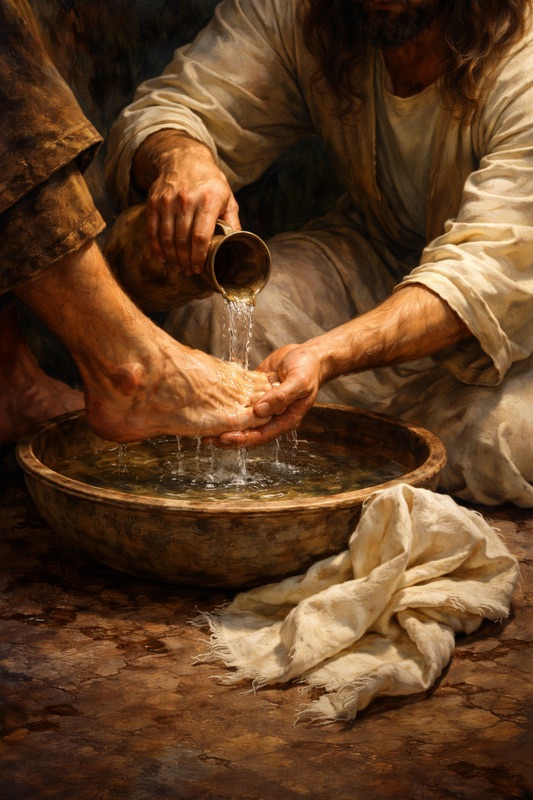
You have seen the water poured, the towel tied low,

The Master kneeling where only servants go.

The dust of their journey upon their weary feet,

The Lord of glory stoops in love complete.


No throne, nor crown, but basin, cloth and grace,

He knows no shame and meets them face to face.

The King of heaven bends to serve the least.

The Lord becomes the servant at their feast.


“If you know this,” they hear Jesus quietly declare,

“Then blessed are you when love demonstrates your care.”

Not words alone, nor knowledge held inside,

But hands that serve where simple needs reside.


So take the path where pride is laid aside,

Where mercy walks among us and self is crucified.

For joy is found where humbled hearts agree:

To follow Jesus is to serve, and so be free.

Monday, April 6, 2026

Spiritual Band-Aids

They have healed the wound of my people lightly,

saying, ‘Peace, peace,’

when there is no peace.

Jeremiah 8:11

Here a tragic reality is exposed for Israel and Judah: their leaders spoke false comfort when obedience and conviction were needed. Priests and false prophets assured the people, “Peace, peace”, while hearts were still hardened and sins unrepented. They should have confronted idolatry, injustice, and unfaithfulness. Instead they soothed consciences with empty positivity. The people ate it up, preferring positive drivel over true calls to repent and return to Yahweh. Both leaders and people accepted a false security built upon denial rather than upon God’s revealed truth.

God’s response through His prophet is not indifferent. He confronts their illusion and shatters it. He declares judgment will surely come: there was nothing to the promises to false positivity — no harvest, no figs, and the land will be laid waste (Jeremiah 8:13). This is the opposite of the smooth sweet-talk band-aid the leaders used to cover the wounds of the nation. Deep wounds would instead be riven in judgment. The people will experience the consequences of rebelling. God will expose their religious language and outward appearances as false. He desires truth inside of them, and they would find it only in His judgment for their refusal to pay heed to His calls to repent. What was declared “peace” by liars is overturned by the truth and the reality of God’s actions.

The principles in this passage call us to beware of shallow human assurances and instead anchor only in the true peace found in the gospel of Jesus Christ. To do that we accept the hard truth: we were sinners bound for hell needing a Savior to die for us. He did so and was raised to life for our eternal hope. We do not try to minimize this sobering reality. In Jesus the wound of our sin is not merely covered in pious words, but in the blood of Christ that rescued us by His cross and resurrection. In Jesus we are not just merely covered… we are healed. We never minimize the depth of our wounds nor the intensity of the gospel remedy! We don’t need “ten leadership principles” or “six ways to feel better about yourself” as messages! We need the truth of the gospel and the reality of God’s grace to shake us and shape us! Therefore, we rest in the faithful Word of Christ… by His wounds we are healed and in Christ alone is lasting, real, and eternally secure peace.

Friday, April 3, 2026

Poured out

Jesus said, “Leave her alone, so that she may keep it for the day of my burial. For the poor you always have with you, but you do not always have me.”​  John 12:7-8

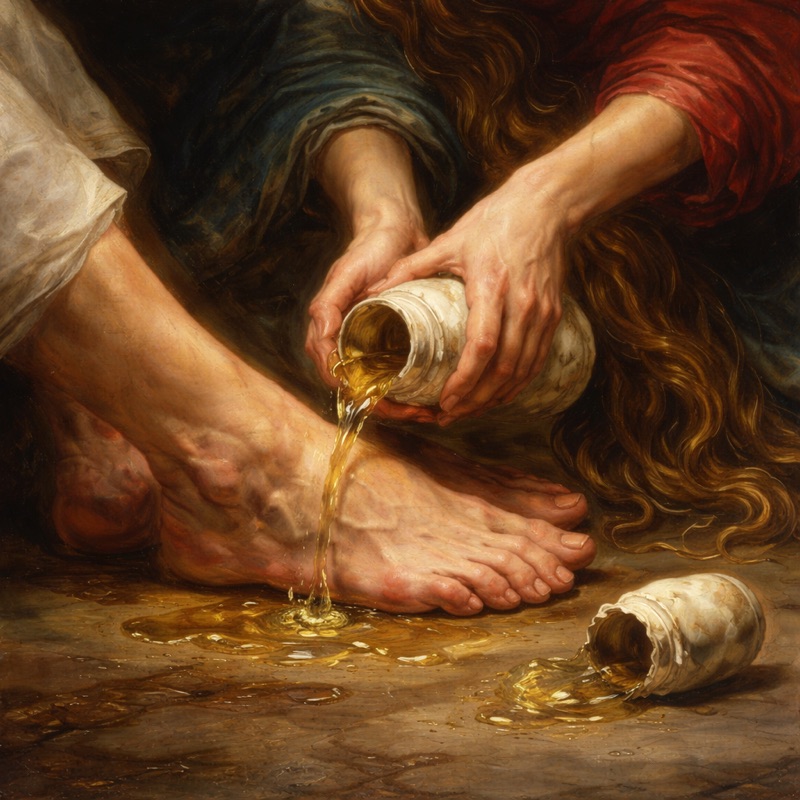
Mary’s gift to Jesus in John 12 is extravagant, humble, total, and irrevocable. What she did will always be told and could never be taken back.

She poured out her costly perfume, knelt to the floor, and wiping Jesus’ feet with her hair, held nothing back. It was total submission, total worship, and total sacrifice.

Today, on Good Friday, we recall an even greater outpouring: Christ pouring Himself out fully over our sin. Mary’s devotion becomes in a sense our call to worship as we see Jesus poured out for us.

Do not offer to Jesus leftovers and remnant pieces; offer Him your entire life — your best time, your valued treasures, and your entire heart! Let your worship of your devoted Lord be costly, your repentance sincere, and your tearful love visible. He was all that for you on the cross.

As the fragrance of Mary’s irretrievable commitment filled the house, may your consecrated life fill the place where God has placed you as you devote yourself today to your crucified, glorified, and now magnified Savior.

Thursday, April 2, 2026

You are merciful.

“But even in those days, declares the LORD, I will not make a full end of you.”  Jeremiah 5:18

Even when Your people totally neglect You… You, O God, are merciful.

You restrain from total destruction.

     You do not make a “full end”.

     You reserve and preserve.

You remember Your covenant.

     You are faithful in Your promises.

     You fulfill Your long-term purposes.

You forewarn of coming judgment.

     You invite repentance.

     Your first desire is to renew and restore.

You discipline rather than destroy.

     You keep a faithful remnant.

     You fulfill Your hope in the survivors.

You call to repentance.

     You give advance warnings.

     You appeal to faith and commitment.

You reveal Your righteousness.

     You act in perfect justice.

     You expose in love our sin and deception.

You open the door to future glory.

     You always leave room for growth and change.

     You point to the ultimate gospel redemption in Christ with words of renewal, return, and revival.

Wednesday, April 1, 2026

He is present, powerful, and personal.

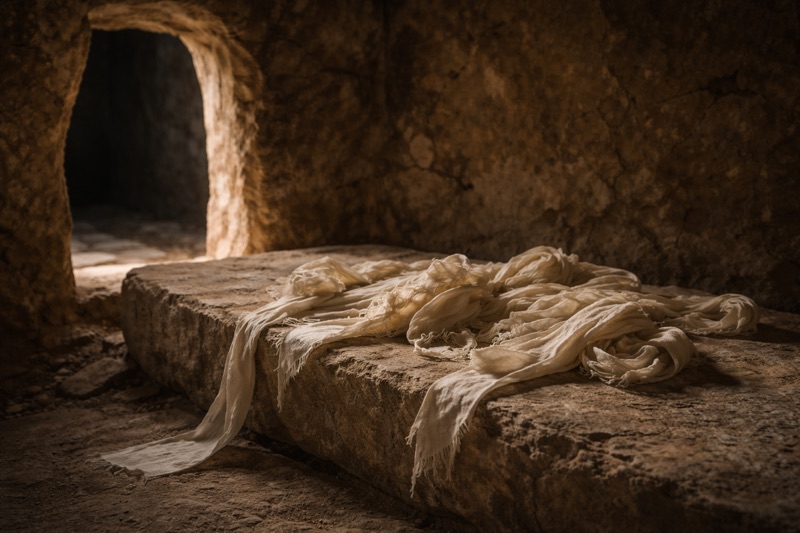
The man who had died came out, his hands and feet bound with linen strips, and his face wrapped with a cloth. Jesus said to them, “Unbind him, and let him go.”  John 11:44

Mary, Martha, and the disciples all respond to Jesus with both genuine faith and limited understanding. Martha greets Jesus with a confident yet incomplete faith: “Lord, if you had been here, my brother would not have died” (John 11:21). She believes in a future resurrection but Jesus draws here faith to Him in the moment, declaring, “I am the resurrections and the life” (John 11:25).

Mary comes weeping and falls at Jesus’ feet with some of the same thoughts as Martha. Her grief, however, is visibly overwhelming. Here sorrow moves Jesus deeply as He weeps with her, showing that lament meets faith in deeply personal ways.

The disciples struggle with confusion and fear. Thomas speaks for their resignation to face whatever may happen: “Let us also go and die with him” (John 11:16). Some of them question Jesus’ timing and delays. Together, the disciples are a mosaic of fear, belief, and doubt — loyalty mixed with emotion and uncertainty.

What unites all three groups is that they all engage with Jesus. Martha has her questions. Mary has her tears. The disciples have their obedience while struggling with confusion. Jesus does not reject any of them. He gently corrects Martha’s limited viewpoint, He shares in Mary’s weeping, and He patiently leads the disciples forward. In each case, more glory is seen in Jesus, not just in raising Lazarus from the dead, but in His sovereignty over human mortality, it’s deep impact, and His compassion in human sorrow.

For us, this is deep encouragement: faith does not require perfect emotional control or complete theological understanding (Praise the Lord!). We can have questions… and sorrows… and faltering following… and Jesus receives us, loves us, and works miracles in us still! Jesus is not distant in our suffering. He is present, powerful, and personal in all our pain. This is the Jesus Who brings life to our loss, over and over again.